
Have you ever experienced a situation where someone questioned your self-respect? Or have you ever doubted whether you are slowly losing your self-respect?
Obviously, many of you must have experienced one-sided love at some point in your life. It probably reminds you of those days when, in the process of trying to over-please someone, you ended up devaluing yourself. In the effort to gain that one person’s attention, you may have even lost a sense of your own identity.
Trust me, if your answer is yes, you are not alone. Many people go through this feeling at some point in their lives. In fact, it is believed that nearly 7 out of 10 people in the world experience something similar at some stage.
In this blog post, we aim to understand the true meaning of self-respect and identify the signs that indicate you might be losing it. In the end, we will also learn how to fix this issue and protect your self-respect from being compromised.
What is Self-Respect?
Defining self-respect can be challenging due to its subjective nature and the variations it can take across different scenarios and circumstances.
Self-Respect Definition
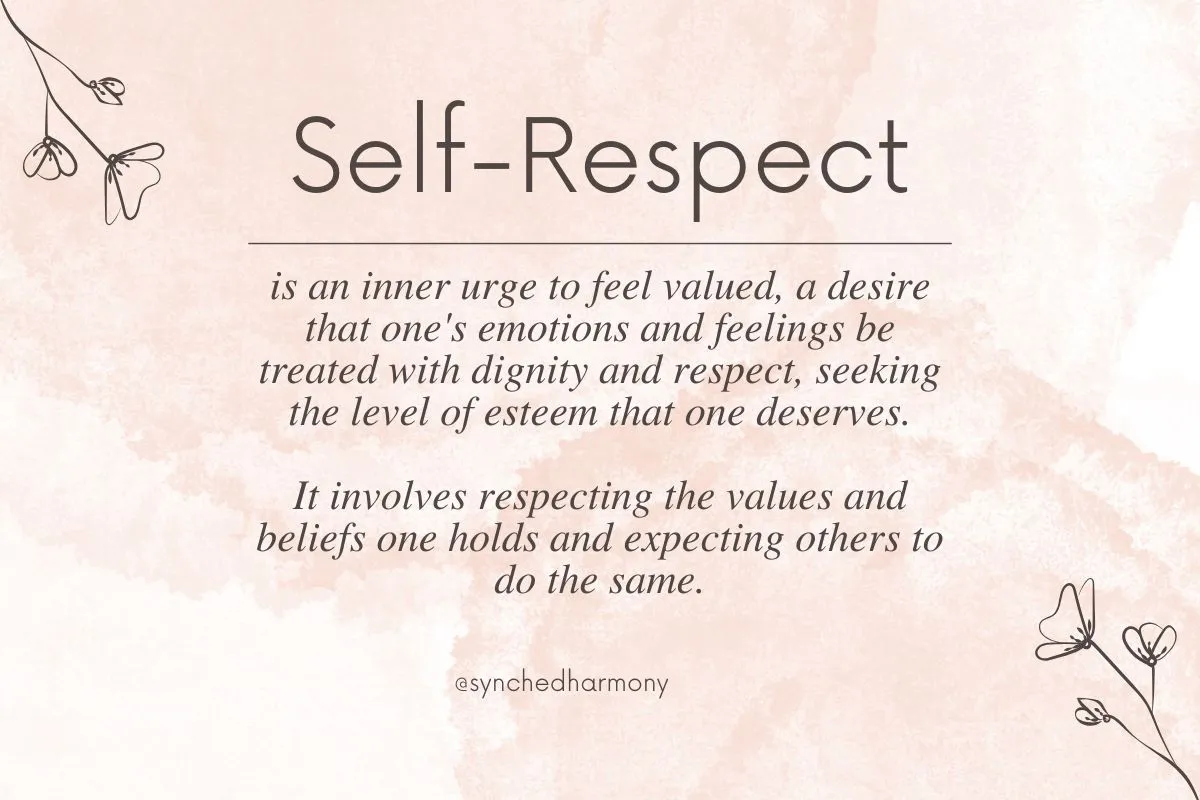
I define self-respect as an inner urge to feel valued, a desire that one’s emotions and feelings be treated with dignity and respect, and a quest for the esteem one deserves. It involves respecting the values and beliefs one holds and expecting other people to do the same.
The role of the inner urge for validation in self-esteem is astute. Indeed, seeking validation and feeling valued are fundamental human needs. Self-respect primarily revolves around the self rather than others. It is important to understand that self-respect is primarily about respecting yourself, rather than expecting others to respect you.
Indeed, it’s not about showcasing superiority over others, but rather, it’s about communicating that you operate within a framework of principles and values. Crossing the boundaries of this framework goes against your principles, and others need to understand and respect that.
8 Signs You’re Losing Your Self-Respect
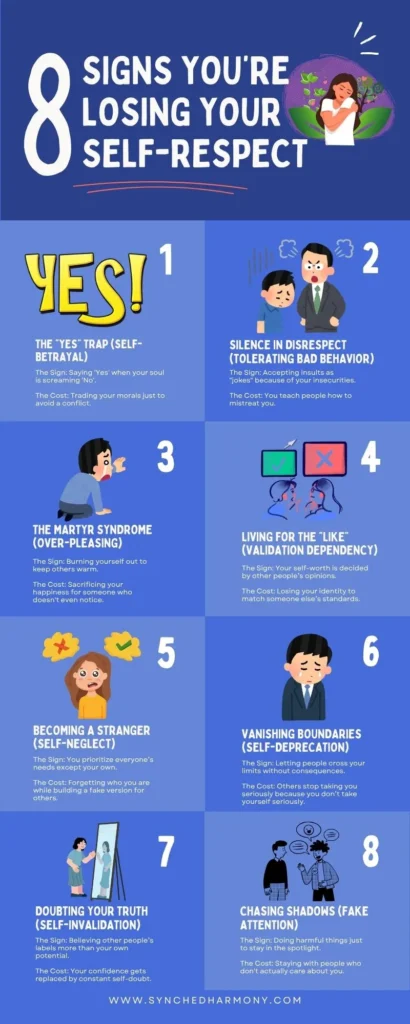
- Self-Betrayal – You say yes to things that go against your morals and principles. Deep down, you want to say no, but you still agree just to maintain peace. Later, you find yourself filled with regret, wondering why you went along with something you knew was wrong. For example, you might start drinking alcohol just to appear “cool” because someone encouraged you to do so—even though you didn’t actually want to.
- Tolerate Disrespect – Instead of standing up against certain things, you begin to tolerate them. Even when someone makes fun of you, and it doesn’t feel right, you choose to endure it rather than speak up. This often happens because the subject of the mockery is your insecurity, and over time, you start living under the weight of it in silence. For example, being bullied in school or college and silently enduring it instead of speaking up.
- Overly Pleasing – You sacrifice your own happiness for the sake of someone else’s, yet it makes no difference to them because it simply doesn’t matter as much to them. Realizing this can leave you feeling deeply hurt. For example, giving everything of yourself in a one-sided love.
- External Validation Dependency – You start taking other people’s opinions too seriously, and it begins to affect your self-confidence. What matters more to you is not what you think about yourself, but what others think about you. Gaining their validation becomes your top priority. You begin to see yourself through their eyes rather than your own. For example, constantly adjusting yourself according to others, following their ways just to match their level, and feeling accepted as part of their group.
- Self-Neglect – As a result, you begin to neglect yourself. Your entire world starts revolving around pleasing others, and you forget to take care of yourself. You no longer feel as important to yourself as the people you are trying to please—many of whom may not even deserve your care and attention. For example, adopting a fake personality that others may like, even though it does not reflect who you truly are in real life.
- Self-Deprecation – You allow others to cross the boundaries set by you, and you have stopped taking it seriously, even when they clearly overstep their limits. As a result, people stop taking you lightly. They feel free to say whatever they want and walk away, while you struggle to respond and end up feeling hurt or offended internally. For example, someone may insult you on sensitive topics, and you still choose to remain silent.
- Self-Invalidation – You become so insecure internally that you start doubting your own abilities. You begin to treat other people’s opinions as the absolute truth, which erodes your confidence in your own capabilities. As a result, self-doubt starts to take over. A clear example of this is fat-shaming or making fun of someone solely based on their appearance.
- Fake Attention – You fall into the trap of seeking fake attention. You prefer to stay around people who don’t genuinely want to be with you, and in an effort to gain their attention, you start doing things that further lower your self-respect. For example, adopting unhealthy or harmful habits just to gain respect or approval in the eyes of others.
How to Maintain Your Dignity and Self-Respect
- Set Clear Boundaries – Set your morals and principles clearly, and build personal standards around them—standards that no one should be able to break. These are boundaries that neither you should cross nor allow others to violate. Use these principles to decide what is right and wrong for you, and define your boundaries accordingly. For example, you might decide: “I will never consume alcohol or cigarettes just to impress someone”.
- Distance Yourself From Toxic People – Distance yourself from people who make you feel uncomfortable. Treat them as if their presence holds no value in your life—whether they are around or not, should not affect you. Always choose mental peace over mental harassment.
- Value your Emotions – Value your own emotions more than those of others—you also deserve self-care from time to time. Your feelings matter. You are human, and it is completely natural to feel hurt by certain things. It is perfectly okay to express your disagreement when something goes against your morals and values.
- Stop Overpleasing – Stop chasing people excessively—not everyone is worthy of your time and attention. When you let go of the habit of over-prioritizing others, you create space to focus on yourself and on those who truly deserve your time. Keep your approach straightforward. If you’ve made an effort once and it didn’t work out, move on. There’s no need to waste your time. The people who genuinely care about you will come back on their own.
- Speak Up – Learn to respond when it is necessary, avoid getting bullied —staying silent all the time will not solve anything. Sometimes, you have to fight your own battles on your own; no one else will come to do it for you. If someone is bullying you, stand up for yourself and put a stop to it—even if it means confronting them once. More often than not, when you set that boundary firmly, they think twice before bothering you again.
- Recognize Your Strength – You are not weak; you have only conditioned yourself to feel that way through your thinking. Change that mindset. Make yourself your own competition and discover your true potential by challenging your limits. There is always something unique about you that sets you apart from others. For example, you may be an introvert and not very comfortable with socializing, yet you might excel at public speaking. Once you understand your strengths, you can work on refining and strengthening them further.
- Take Stand – Take a stand for yourself. Be firm against anything that goes against your morals and principles—even if it means losing respect in the eyes of others. For example, if you believe that bullying is wrong, then stand by that belief and refuse to hurt someone just to fit in or gain approval. What truly matters is that you continue to feel proud of yourself.
- Build Aura – Build an energy around yourself where you are not seeking people, but people are naturally drawn to you. Create a positive aura that others feel comfortable and attracted to. When you focus on your authenticity, people will naturally be impressed by your personality and appreciate you.
Also Read: Never Argue with a Fool, Idiot or Stupid Person: 10 Reasons Why
Understanding Self-Worth – Why is it Important?
Self-worth is the foundation of personal integrity and emotional well-being. It reflects an individual’s recognition of their worth and their ability to stand by their principles and values, even in challenging circumstances. Unlike ego, which often seeks validation through external comparison, self-worth is deeply rooted in self-awareness and self-acceptance.
Key Aspects of Self-Worth
- Valuing Yourself: At its core, self-worth is about acknowledging your intrinsic value and treating yourself with kindness and dignity. This includes refraining from self-criticism that undermines your confidence and setting realistic standards for personal growth.
- Setting Healthy Boundaries: A significant element of self-esteem is establishing and maintaining boundaries. This helps protect your mental and emotional space, ensuring relationships are built on mutual respect.
- Living with Integrity: Self-worth involves aligning your actions with your core values. Doing so creates a life that feels authentic and fulfilling, reducing regret and self-doubt.
- Cultivating Assertiveness: Assertiveness is key to preserving self-respect. By confidently expressing your needs and opinions, you maintain your boundaries without disregarding others’ feelings.
Verywell Mind (2022) highlighted that a strong sense of self-respect is linked to improved emotional well-being and healthier relationships. It is indeed a profound step towards building self-worth.
I Lost My Self-Respect Chasing Attention (My Personal Story)
I never imagined that I would fall this far…
to the point where I completely lost myself in the pursuit of one-sided love.
But looking back, it wasn’t really love.
It was stubbornness… something that started as a reaction to rejection.
—
I failed to understand the difference between friendship and love.
Even the smallest smile… a simple laugh at my words…
felt like a sign of affection to me.
—
The truth is, I was immature.
I rushed into something that needed time.
And even when I knew deep down that nothing would come out of it…
I still held on.
—
She explained everything to me politely.
She believed I would understand and move on.
But instead of accepting it…
I took it as a blow to my self-confidence.
—
In the pursuit of one-sided love,
I ended up doing everything I shouldn’t have done.
In trying to win her over…
I slowly started losing my self-respect.
—
I hurt myself so much in the process
that I didn’t even realize
When I became a source of mockery for others.
—
And in the end…
a friendship that could have lasted forever
came to an end.
That thought kept breaking me from within.
—
Things did fall apart.
But I didn’t let my emotions fall with them.
Slowly, I brought myself back on track.
I stepped out of that dream world…
and started facing reality.
—
I reminded myself
that there is much more in life
that I still need to achieve.
—
My focus shifted.
From chasing someone…
to doing something meaningful for the people who truly matter.
—
I picked up my studies again
from where I had left off.
And I started putting my energy
into building my career.
—
I realized—maybe a little late—
that there is far greater peace
in fulfilling my parents’ dreams
than in chasing one-sided love.
—
It wasn’t easy.
But I was lucky.
I had friends who helped me stand back up
during those difficult moments.
—
Yes, this phase marked the beginning of downs in my life.
But I am proud of myself for staying strong.
Even during my weakest moments…
I didn’t lose focus on what truly mattered.
—
It was painful.
But today, I see it
as one of the biggest lessons of my life.
—
If you’ve ever been through something like this…
You’ll understand how easy it is to lose yourself
when you start seeking your worth in someone else.
Also Read: Confidence vs Arrogance – 10 Clear and Bold Differences
Conclusion
To conclude, it is important to understand that self-respect is primarily about respecting yourself rather than expecting others to respect you. It is an inner need to feel valued—a desire for your emotions and feelings to be treated with dignity.
Self-betrayal, self-neglect, and an excessive need to please others are key signs that you may be losing your self-respect. Allowing others to cross your boundaries and remaining silent when something goes against your morals and principles only weakens your self-respect and makes you more tolerant of disrespect.
However, understanding your worth and setting clear boundaries can help you distance toxic people from your life so that you can focus on identifying your inner strengths and building a positive aura around you.
If you found this article helpful, consider sharing it with your family, friends, and colleagues who might benefit from reading it. For more such content, subscribe to Synched Harmony and become a part of our community focused on clarity, practical solutions, and personal growth.

Hello, I’m Shubhankar — the voice behind Synched Harmony.
I created this space with one simple vision: to help people solve real problems with practical solutions and clarity. I’m someone who believes most confusion in life doesn’t come from lack of intelligence, but from lack of clear thinking and perspective. Through my writing, I try to break down everyday struggles into a simple, usable understanding. I write from my own reflections, observations, and real-life experiences—not theoretical advice. I’m not here to give perfect answers, but to offer clearer perspectives that actually make sense in real-life situations. Because I believe life becomes easier when we stop overcomplicating things and start understanding them better.