
Updated June 2026 | Originally published April 2024
Quick Answer: What Is the Difference Between Confidence vs Arrogance?
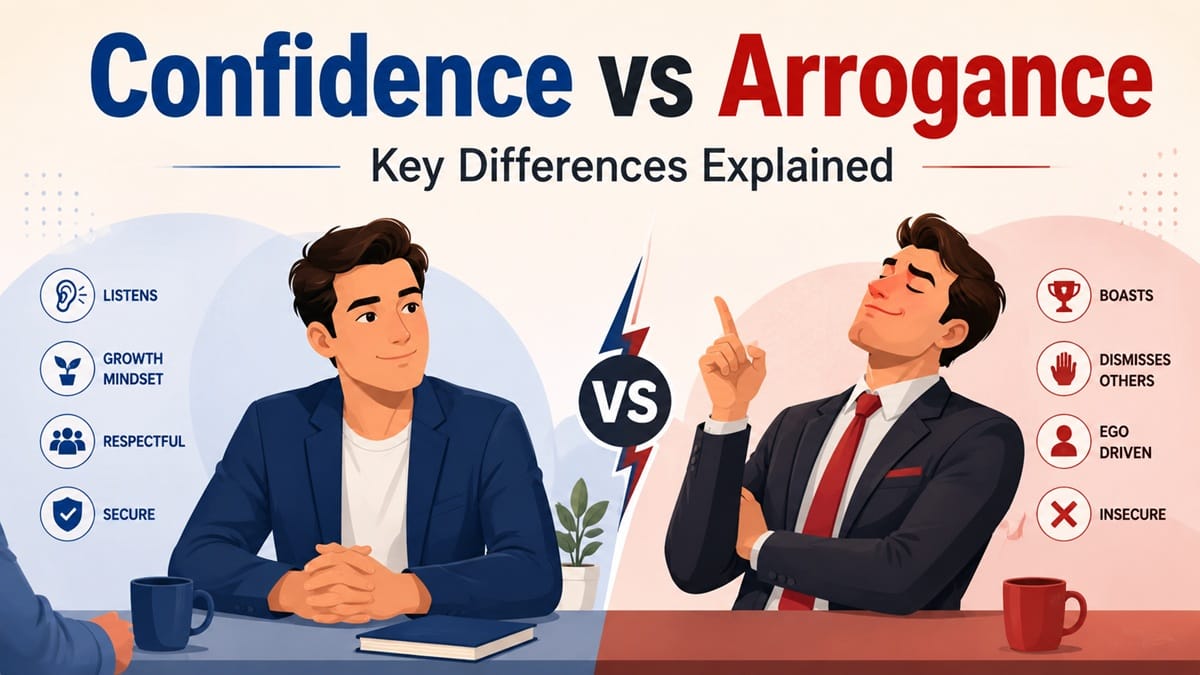
Confidence is a quiet inner belief in your abilities, grounded in skill and experience, that motivates you to perform well and collaborate positively with others. Arrogance, by contrast, is an inflated sense of superiority that disregards others’ abilities and often involves boasting or dismissing different perspectives. While confidence builds trust and respect, arrogance can harm relationships and isolate individuals. Source: pmc.ncbi.nlm.nih.gov
Introduction
Confidence doesn’t need to boast—their silence often says it all. Meanwhile, arrogant individuals loudly praise their abilities to showcase them to others. There’s a fine but crucial line between confidence and arrogance that is easy to cross without realizing it. This article explores this distinction with clarity and details 10 clear differences between the two traits. Source: pmc.ncbi.nlm.nih.gov
Today, we will delve into understanding the fine line between confidence and arrogance and we’ll also grasp 10 clear and bold differences between confidence and arrogance.
Understanding Confidence
What is Confidence?
Confidence is an inner feeling motivating you to perform effectively in any situation. It originates from a belief in your abilities, skills, knowledge, and values. This belief helps reduce anxiety, improve focus, and provides a competitive edge through competence. Source: psycnet.apa.org
If I share my point of view, confidence is a strong inner feeling that motivates you to do well in any situation. It’s a strong gut feeling that instills belief in your abilities and inspires you to tackle tasks in front of you with simplicity and skill. It aims to provide you with a competitive edge over others through your abilities and skills by enabling you to perform at your best caliber. It triggers a feel-good sensation that dispels anxiety and tension, enhancing your focus on the current task.
Self-Confidence vs Confidence in Others
From the perspective of this blog article, whenever I mention confidence, I actually mean self-confidence, and specifying this is important because confidence can be broadly classified into two types: Confidence in Oneself (Self-Confidence) or Confidence in Others (Trust).
Self-Confidence: The simple meaning of self-confidence is having trust and faith in yourself. That means trusting on your abilities, skills, knowledge, mindset, and values you hold. Self-confidence grows with experience. The more challenging scenarios you face in your life, the more your self-confidence grows because you learn new ways to tackle those challenging situations.
I would say it’s a journey from being a novice in a particular area to becoming an expert in that field. Self-confidence increases when you have the right knowledge, skillset, and zeal to do things and learn continuously. Self-confidence increases with practice. You must have heard the famous saying by martial artist Bruce Lee, “I fear not the man who has practiced 10,000 kicks once, but I fear the man who has practiced one kick 10,000 times”.
It’s crucial to understand that your self-confidence should never turn into overconfidence, which mostly happens when you overlook others’ capabilities or fail to correctly assess the current task’s complexity. You can’t become an expert in any field overnight or in a few days; it often requires a lot of hard work and continuous practice. But if you feel this statement doesn’t seem correct, then it’s your overconfidence speaking, not confidence.
What is Trust?
Trust is confidence in others—the belief in their honesty, capability, and sincerity. It’s earned over time and is essential in teamwork. Even when your confidence fluctuates, trusting your team or others can bolster success. Trust and confidence interlink, each reinforcing the other. Trust is earned when someone earns your confidence, and in turn, you feel optimistic that they will meet your expectations.
I think trust plays a pivotal role, especially in circumstances where teamwork is crucial. In such conditions, even if your self-confidence is high, if you or your team lack trust in each other, the chances of failure increase significantly. On the other hand, when your confidence wavers a bit, trusting your team can help boost your confidence and contribute to success.
Trust plays a significant role in building confidence. Your confidence automatically increases when you start trusting yourself, your skills, and your capabilities. Similarly, when someone meets your expectations, you start trusting them because they have earned that confidence in your eyes.
Understanding Arrogance
Arrogance starts where confidence becomes excessive. It involves seeing oneself as superior to others and dismissing others’ knowledge or capabilities. Merriam-Webster defines arrogance as “an attitude of superiority manifested in an overbearing manner or presumptuous claims or assumptions.”
Arrogance can develop gradually as confidence grows but crosses the line when it evolves into prideful disregard for others. Such behavior can damage relationships, diminish learning, and isolate the arrogant individual.
In arrogance, you start viewing yourself as superior and expect others to see you the same way. As per Merriam-Webster, Arrogance is defined as an attitude of superiority manifested in an overbearing manner or presumptuous claims or assumptions.
Arrogance comes when someone is too proud of themselves and looks down on others. And that’s why, when discussing confidence vs. arrogance, it’s crucial to keep your arrogance in check, because you may not realize when your confidence has crossed into arrogance.
10 Clear and Bold Differences Between Confidence vs Arrogance
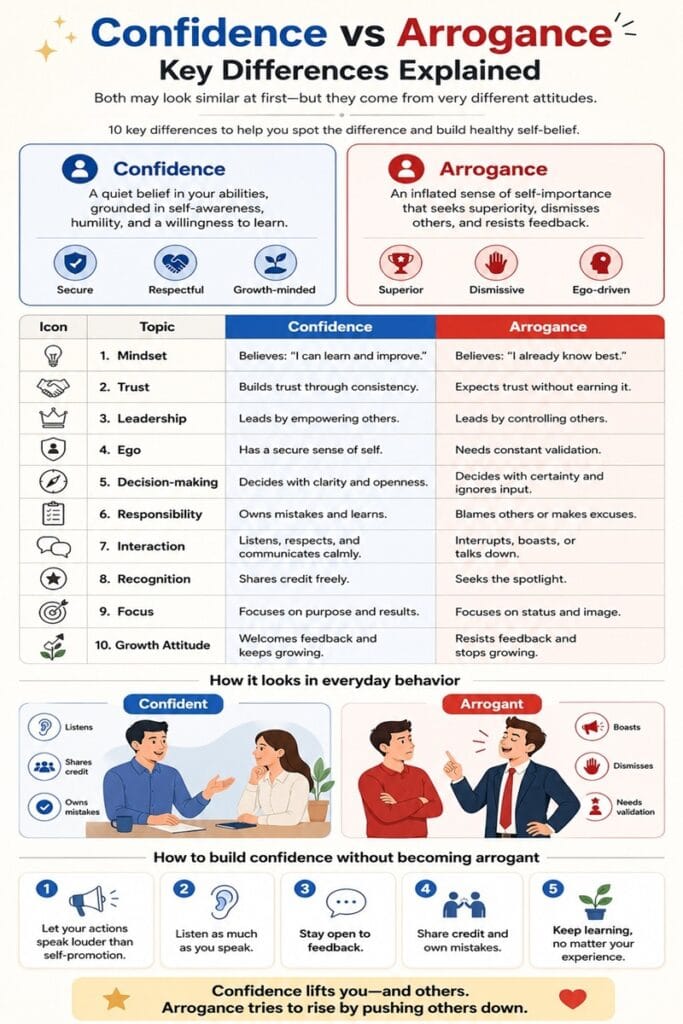
1. Smartness vs Over Smartness
When we talk about a confident person, the first thought that comes to my mind is about their smartness. Usually, confident individuals are quite smart as well. They are known for their quick-witted intelligence and have groomed themselves in a way that they can analyze situations quickly and take independent actions. They smartly analyze the situation, consider all possible outcomes, and decide upon an action. Instead of blindly guessing, they prefer making calculated moves.
On the other hand, arrogant people exhibit oversmartness. They believe that their thoughts are always correct, and they tend to stick to the plan of action aligned with their perspective. They are not bothered about others’ opinions and mostly view the situation from their limited perspective. In such cases, their judgment can often be wrong, and their oversmartness can lead to unfavorable outcomes, causing situations to worsen.
2. Trusting Self vs Believing in Others
Another differentiating factor between confidence vs arrogance is that an arrogant person trusts only themselves and doesn’t trust anyone else, which essentially means that they have so much confidence in themselves that they cannot trust others. Perhaps this is the reason why an arrogant person sees themselves as superior and others as inferior.
While a confident person trusts in their abilities, they also instill that confidence in others, which allows them to gain the trust of others. They not only believe in themselves but also motivate others to reach the same level of trust and confidence, creating an environment of positivity. Confidence is an important leadership trait that focuses not only on oneself but also on others, promoting a culture of teamwork. A confident person believes in moving forward together with everyone rather than advancing alone.
3. Ego and Superiority Complex
Another thing you often see in arrogant people is that they are quite ego-centric and have a significant superiority complex. This is a major distinguishing factor between confidence vs arrogance, making it easy to identify an arrogant person. Arrogance is usually visible on people’s faces; they repeatedly talk about themselves, and their conversations often revolve around them. They consider themselves superior to others and expect everyone to treat them that way. If someone challenges their superiority complex or ego, they prefer to distance themselves from that person.
A confident person will never consider himself superior to others, nor will he develop such an ego. A confident person will treat everyone fairly and will try to learn new things from others, respecting the fact that people can be at different levels of expertise, but there is always scope for something new to learn. He will rarely talk about himself and will allow others to speak.
4. Calculated Judgement vs Rough Estimation
Arrogant individuals are so overconfident in themselves that they often rely on rough estimations in every situation and plan all their actions based on those rough estimations. Due to their overconfidence, they fail to make calculated judgments accurately, and they complete their work relying heavily on assumptions. These assumptions increase the chances of mistakes in their work, and if a mistake occurs, they tend to blame it on someone or something else, refusing to take any responsibility themselves.
A confident individual works based on calculated judgment, which involves carefully analyzing the situation, considering all aspects, avoiding reliance on assumptions, and calculating the outcomes of each possible input. They mostly believe in the trial and error method, and through this process, they gain enough experience to accurately judge outcomes. Also, a confident person never hesitates to take responsibility for a failed outcome; in fact, they take it as a learning opportunity and gain insights from the failure.
5. Building Trust vs Looking Down on Others
Another highlighting difference between confidence vs arrogance is that a confident individual will always strive to build trust and create an environment of positivity. They will try to instill confidence in others and focus on building a great team. By earning the trust of others, people will recognize them as a great leader.
On the other hand, an arrogant individual will look down on others, constantly making them feel inferior and disrespecting them. They will always try to prove how superior they are compared to others and how others are lagging behind them. Such people never miss an opportunity to belittle others, and as a result, their admirers diminish over time.
6. Gaining Recognition vs Showing Off
Confident individuals gain recognition from others based on their hard work and skills. They don’t need to repeatedly trumpet their achievements because people themselves acknowledge their positive behavior. Confident individuals earn respect in society without having to advertise themselves.
An arrogant person constantly shows off their abilities, repeatedly promotes their achievements, and never misses a chance to boast about themselves. They believe that by repeatedly narrating their accomplishments, their popularity will increase, and they will be successful in proving themselves superior. This is a significant distinguishing factor between confidence vs arrogance.
7. Work in Silence vs Boasting Off
The biggest difference between confidence and arrogance is that confident individuals don’t need to promote their work; they just work diligently and trust their abilities, letting their work speak for itself. They stay focused on their tasks and put in the same effort, regardless of how simple or significant the task may be.
It is this quality that sets them apart and keeps them one step ahead of arrogant individuals. In contrast, arrogant individuals may promote their work as if they have achieved something monumental, regardless of its actual significance.
8. Attracting Like-Minded People vs Being a Tyranny
Confident individuals naturally attract like-minded people because of their skills, abilities, and knowledge, which makes others interested in connecting with them. A confident personality brings positivity even to a dull environment and provides an opportunity for others to project themselves positively. Confident individuals don’t see themselves as the best but strive to become even better. It is because of this quality that people are inspired by them and don’t hesitate to join them.
On the other hand, an arrogant person will try to be a tyrant in the land of the blind, and his followers will also be blind followers like him. Such individuals try to attract people by boasting about their achievements and proving themselves superior to others. They start believing that they are the best in their small world, where only people like them exist. They have a veil of ego and superiority in their eyes, which prevents them from seeing beyond their perspective.
9. Continuous Improvement vs Self-Centered
Another major difference between confidence vs arrogance is that confident individuals believe in continuous learning to improve themselves day by day. They strive to become better every day and gain more confidence in their abilities. They have a zeal to learn something new every moment, which helps them progress significantly in life.
On the other hand, an arrogant person starts considering themselves superior after achieving a milestone. They lose the desire to learn more because they believe they know everything now, and it’s not them but others who need to learn from them. They become so self-centered that they think they have achieved everything, and now the world needs to learn from them.
10. Unconcerned vs Touchy
Lastly, an important trait that differentiates between confidence vs arrogance is that an arrogant person is always hungry for publicity. They always need someone to treat them the way they want, and that’s why they are quite sensitive to people’s opinions. Whether someone speaks well or poorly about them, they always worry about what others think of them.
Such individuals tend to take even small things to heart, which can be a reason for their arrogant and rude behavior. On the other hand, a confident person doesn’t care about what others think of them. They only focus on their work and strive to improve themselves in that aspect.
This is also one of the main differences that you will notice while comparing confidence vs arrogance; arrogant people always feel envious and competitive towards more successful individuals, while a confident person appreciates the positive traits of an arrogant individual as well.
FAQ Section
Q1: Can confidence turn into arrogance traits?
Yes, when confidence becomes excessive and dismissive of others’ abilities, it may cross into arrogance.
Q2: How can I tell if someone is confident or arrogant?
Confident people listen, share credit, and welcome feedback; arrogant people dominate conversations and belittle others.
Q3: Is arrogance always negative?
Generally, yes; arrogance harms relationships and hinders growth. However, some may display arrogance as a defense mechanism.
Q4: Can I build confidence traits without becoming arrogant?
Absolutely. Stay humble, seek feedback, and acknowledge others’ contributions.
Q5: How does trust relate to confidence?
Trust is confidence in others and complements self-confidence; strong trust builds stronger teams and success.
Conclusion
Through this article, we have understood the definitions and meanings of confidence vs arrogance. Additionally, we have learned that there is a very fine line between these two traits, which is easy to cross without even realizing it.
We have grasped that confidence is a strong inner feeling that motivates you to perform well in any particular situation, while arrogance stems from gaining confidence to such an extent that it turns into overconfidence, leading to arrogant behavior.
Furthermore, we have explained the difference between self-confidence and trust, and in the end, we have detailed 10 clear and bold differences between confidence and arrogance. I hope that through this blog article, many doubts related to these behavioral traits have been clarified. If you would like me to cover any related topic in detail in the future, please do let me know in the comments section. I will make every effort to include it in my next blog post.
Sources and References
- Merriam-Webster Dictionary. Definition of Arrogance. https://www.merriam-webster.com/dictionary/arrogance (Foundation for defining arrogance)
- APA PsycNet. “How children reason about intellectual humility vs. arrogance.” https://psycnet.apa.org/doiLanding?doi=10.1037/dev0001991 (Insight into intellectual confidence/arrogance distinction)
- PMC
- Cross-cultural evidence of pride facets. https://pmc.ncbi.nlm.nih.gov/articles/PMC4856297/ (Supports cultural understanding of pride/confidence)
(These sources provide cautious scientific backing without overclaiming.)
Also Read
- 4 Easy Tips to Understand Others’ Mindset
- What Is Self-Respect? 8 Signs You’re Losing It (And How To Fix It)
- A True Relationship is Two Imperfect People Refusing to Give Up

Hello, I’m Shubhankar — the voice behind Synched Harmony.
I created this space with one simple vision: to help people solve real problems with practical solutions and clarity. I’m someone who believes most confusion in life doesn’t come from lack of intelligence, but from lack of clear thinking and perspective. Through my writing, I try to break down everyday struggles into a simple, usable understanding. I write from my own reflections, observations, and real-life experiences—not theoretical advice. I’m not here to give perfect answers, but to offer clearer perspectives that actually make sense in real-life situations. Because I believe life becomes easier when we stop overcomplicating things and start understanding them better.
1 thought on “Confidence vs Arrogance: 10 Clear Differences Explained”