

Last updated: June 2026
Quick Answer
Multidimensional thinking means analyzing problems from multiple perspectives to gain a fuller understanding before making decisions. It helps avoid impulsive choices by uncovering root causes and envisioning consequences through various lenses — emotional, social, financial, and long-term impacts. In Indian workplaces and families, this approach is vital for managing conflicts, making career moves, or handling financial decisions like loans or investments. Source: psycnet.apa.org
Many people make the most important decisions in their lives without careful thought and consideration. Many of us have regretted the decisions we made in the past. We often feel that we made hasty decisions, only to regret them later. But were you able to realize why those decisions went wrong?
The current situation in life is the result of decisions made earlier. Well, this article isn’t focusing on decision-making; however, it will be a deep dive into an important aspect of decision-making that can significantly influence the outcome of your decision, which is Multidimensional thinking.
What is Multidimensional Thinking?
Referring to an article from St. Thomas University, Multidimensional thinking is a form of higher-level thinking where we take a topic or piece of information and view it from various perspectives or dimensions to gain an overall understanding from various angles.
Multidimensional thinking is a higher-order cognitive process requiring you to look at an issue from various angles — emotional, contextual, social, financial — rather than just a single viewpoint. According to research in cognitive problem-solving (Heppner & Petersen, 1982), this approach fosters better understanding and more effective solutions. Source: apa.org
Unlike simply hearing others’ perspectives, it demands deep analysis, connecting differing viewpoints, and identifying root causes rather than surface symptoms.
From the context of synched harmony, Multidimensional thinking involves considering a situation from diverse angles and understanding the perspectives of each view. It requires looking at situations from different viewpoints and grasping aspects that your limited perspective about a particular situation might not be able to comprehend otherwise. It requires understanding the context more comprehensively and comprehending the relationship between different perspectives.
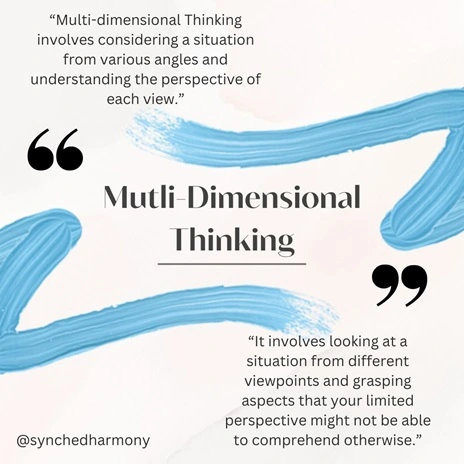
Many people might confuse multidimensional thinking with knowing others’ perspectives. Still, I want to clarify to the audience that there is a slight difference between the two, as knowing others’ perspectives is about listening to their thoughts and views without judging or deriving any inferences from them directly. At the same time, Multidimensional thinking requires deep thinking from different lenses and perspectives to uncover the root cause of the problem.
Quick Tip:
If you want to gain knowledge about perspective and mindset, please feel free to read the links below:
- Must Read: Understanding Others’ Perspective – 10 Valuable Benefits
- Must Read: 4 Easy Tips to Understand Others’ Mindset
Why Is Multidimensional Thinking Important?
Life circumstances, including financial and relational, are outcomes of past decisions. Multidimensional thinking helps reduce regrets by:
- Preventing hasty decisions
- Highlighting hidden risks and opportunities
- Facilitating balanced conflict resolution
Especially in Indian joint families and workplaces, conflicts often stem from complex intertwined causes, such as cultural norms, financial dependence, or career aspirations.
Real-Life Example: Managing Family Disputes
Let’s understand this with a real-life example. Imagine you find yourself caught in a conflict that doesn’t directly involve you—for instance, an internal family dispute or disagreement between two family members that occurred in your absence. Now, to ensure that this disagreement doesn’t escalate into a quarrel, it becomes essential to resolve the matter peacefully. However, when it comes to family members, resolving such issues is rarely as straightforward as it seems. This is because taking one person’s side might disappoint the other. In such circumstances, it’s crucial to handle the situation thoughtfully. This involves listening carefully to both sides, understanding the situation from their perspectives, and then analyzing the matter thoroughly from all angles to uncover the root cause of the problem. Once the root cause is identified, you can propose a mutually agreeable solution, creating a win-win situation for both parties.
Other examples of Multidimensional Thinking:
- Imagine intervening in a family dispute where two relatives disagree over financial contributions toward a household EMI. Taking just one side can cause resentment. Instead, listening actively to each view, evaluating the financial capabilities (monthly salary, other EMIs), familial expectations, and longer-term harmony is crucial.
- Designing a product often utilizes multidimensional thinking where one has to consider several aspects such as consumer requirements, technological limitations, raw material quality, etc. before making a decision.
- Addressing social and political issues requires considering scientific, economic, political, social, and technological dimensions.
- Setting and achieving SMART goals for personal development.
Must Read: 10 SMART Goals For Success in 2025
Quick Tip:
Multidimensional thinking is a higher-level cognitive process that requires critical, deep thinking. For effective deep thinking, it is essential to be in a calm and distraction-free environment. To engage in multidimensional thinking, having a pen and paper at hand is crucial, as it allows you to jot down your observations and structure your thoughts systematically.
Multidimensional Thinking Techniques?
Thinking from several lenses is a complex process, and it’s not something you can grasp in one go. It can take several days or even weeks, and having a calm demeanor and a positive mindset are crucial aspects of it. You can approach Multidimensional thinking in the following ways:
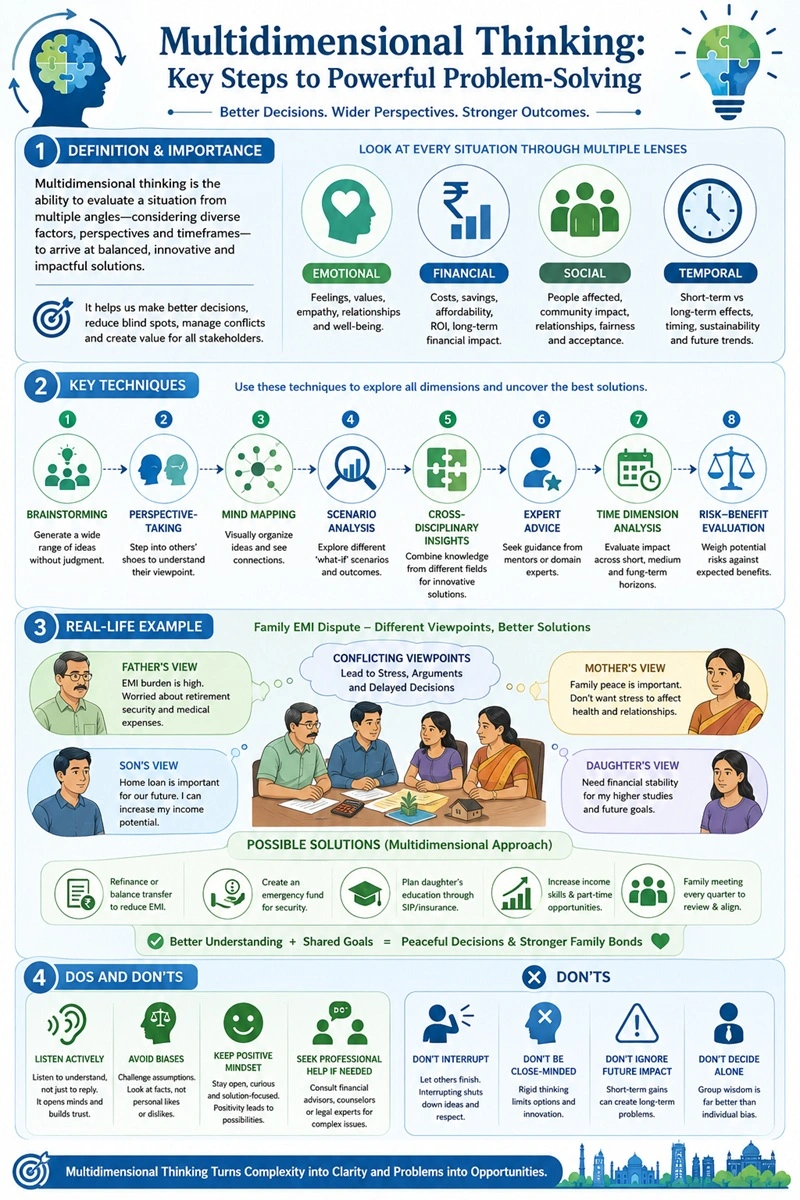
- Brainstorming: Brainstorming is a good way to trigger multidimensional thinking. However, it’s important to understand that you may not want to brainstorm ideas with those directly involved in the conflict. Instead, you should brainstorm with someone who has no involvement with the people involved in the conflict and who can provide unbiased opinions about the situation.
- Perspective-Taking: Perspective-taking can also trigger multidimensional thinking where you first listen to the viewpoints of others and then consider them from different scenarios and perspectives to help you gain a better understanding of the overall situation.
- Mind Mapping: With mind mapping, you visualize the situation in your mind and then try to fit all the scenarios in place accordingly. This allows you to think in various ways and helps you frame your perspective about that situation. Mind mapping is all about your thoughts, which can change after learning about the viewpoints of others.
- Scenario Analysis: Scenario analysis is about imagining different scenarios connected to the situation and then deeply contemplating each scenario to form your perspective on it. For instance, in a particular scenario, you think about what happened, why it happened, what triggered it, and what potential consequences could arise from it.
- Cross-disciplinary Insights: With the help of cross-disciplinary insights, you can utilize knowledge from other fields to foster multi-dimensional thinking. For instance, by learning about the psychology of human minds, you can approach problems with a new perspective where you will be in a better position to handle people’s mindsets and behavior.
- Expert Advice: Consulting with experts in the field or individuals with relevant experience can also help gain diverse perspectives. They can provide guidance that others might not be able to, and they can help focus your attention on aspects that you might not have thought of yourself.
- Time dimension Analysis: In time dimension analysis, you attempt to understand how any problem or situation has evolved. Also, you try to comprehend when it originated first and how far it has escalated. This helps you recognize patterns that might have been observed beforehand which are of repeating nature that could also be the potential root cause of the issue.
- Risk and Benefits Evaluation: In a risk vs. benefit analysis, you assess the potential risks and benefits of a decision before making it. It’s essential to thoroughly understand all aspects so that you’re aware of the associated benefits of the choice you’re about to make and the potential risks it entails.
Techniques to Develop Multidimensional Thinking
- Brainstorming: Discuss ideas with impartial friends or colleagues, not those involved, to avoid biased input.
- Perspective-Taking: Listen genuinely to other viewpoints; imagine scenarios from their context.
- Mind Mapping: Draw scenario trees showing causes and effects — for example, how a salary hike affects savings, tax, and lifestyle.
- Scenario Analysis: Envision best and worst-case outcomes of decisions, such as delaying a job switch by one year.
- Cross-disciplinary Insights: Use finance, psychology, and social knowledge to enrich your understanding.
- Expert Advice: Consult a financial adviser, HR, or counselor for professional insight.
- Time Dimension Analysis: Trace how the problem evolved, e.g., how family debt increased over months.
- Risk-Benefit Evaluation: Measure potential gains like higher income against risks like job insecurity.
How to Think From Different Angles — Practical Steps?
- Start by identifying emotional drivers behind reactions (stress, frustration).
- Break down the problem into smaller parts using pen and paper.
- List stakeholders’ pain points and possible motivations.
- Reflect on your perspective after absorbing others’ views.
- Maintain a positive mindset aiming for long-term harmony rather than short-term wins.
- Consider gradual solutions and communication strategies to gain agreement.
My Personal Approach to Multidimensional Thinking
From my personal experience, whenever I encounter a conflict or a difficult situation, I try not to focus immediately on what someone did wrong. Instead, my first question is usually: Why did they react this way? Understanding the reasons behind a person’s behavior often reveals important context that may not be visible at first glance. By listening to different perspectives, I have frequently discovered valid concerns that needed to be addressed before any meaningful solution could be found.
For me, multidimensional thinking is the practice of moving beyond a narrow, one-sided perspective and examining a situation from multiple angles. It allows us to consider realities that may not fit perfectly into an ideal scenario. For example, in a family dispute, it is not enough to simply determine who is right and who is wrong. It is equally important to understand the emotional pain, concerns, and expectations of everyone involved. Once these factors are understood, the focus can shift toward finding solutions that genuinely improve the situation for all parties, while also evaluating whether moving forward together is realistically possible.
One thing I have learned is that multidimensional thinking cannot always happen entirely in your head. Complex problems often become clearer when they are written down. Whenever I am trying to understand a difficult situation, I break it into smaller, manageable parts. I identify the key issues, write down the concerns associated with each one, and then analyze them individually.
Next, I list the perspectives, motivations, and pain points of everyone affected by the situation. This process helps me build a more complete picture of what is actually happening, making it easier to identify practical and balanced solutions.
Another principle I follow is first to consider whether the problem can resolve itself without my direct involvement. Sometimes people need time, space, or an opportunity to communicate with each other. If a situation can naturally move toward resolution, unnecessary intervention may only create additional stress.
When intervention is necessary, I try to understand the circumstances that may have caused someone to behave unusually or react out of frustration. At the same time, I ask an important question: Even if I understand and sympathize with their perspective, does that automatically justify their actions? Understanding someone’s reasons and approving of their behavior are not always the same thing.
After examining the viewpoints of others, I consciously reflect on my own perspective. Rather than accepting any single viewpoint as the complete truth, I use multidimensional thinking to evaluate all available information and form an independent conclusion.
Perhaps the most important aspect of this approach is maintaining a positive mindset. The objective should never be to prove someone wrong or escalate the conflict. The goal is to improve the overall situation. A positive mindset encourages solution-oriented thinking and helps us look beyond immediate disagreements. It also allows us to consider the long-term consequences of our decisions, aiming not just for temporary relief but for lasting resolution.
Finally, after considering all relevant factors, the conclusion may not always satisfy everyone in the short term. In some cases, the best long-term solution may initially appear unfavorable or unpopular. When that happens, it becomes important to communicate the reasoning behind the decision and help people understand how it can ultimately benefit them in the future.
This is how I personally apply multidimensional thinking—not as a tool for winning arguments, but as a framework for understanding people, solving problems, and creating outcomes that are sustainable in the long run.
Quick Tip:
Here’s a bonus piece of advice, When you’re unable to comprehend something on your own, discuss it with a trustworthy individual who has no common connection with the people involved in the conflict. There can be two benefits to this approach. First, you can have an open conversation with them, and second, they can offer an unbiased opinion about the issue.
Why is it important to look through different angles?
We often find ourselves in situations that are not directly related to us, and we get pulled into them involuntarily because the people involved in that situation are the ones that we care about.
- Using multidimensional thinking can gradually help clarify many things that often remain unknown. This allows you to take a step in the right direction to normalize conflicts and resolve them.
- Avoiding a complex situation every time can weaken the relationship bonds within the household, so it is necessary to handle them properly and maintain an equilibrium, it is important to understand how to tackle it in a manner that avoids unnecessary drama and resolves the problem peacefully which relates to a famous saying, “Kill the snake without breaking the stick.”
- Thinking from a different lens can expose several truths that may uncover hidden aspects of the problem and the root cause of the situation. The approach of multidimensional thinking is based on a thorough understanding of the situation without any biases involved. The ability to listen to others and comprehend things is a skill that not everyone possesses.
- Listening requires patience on your part, and it is equally important to refrain from asking too many questions while listening to others. Simply listen to them and allow them to express their feelings and emotions. When you actively listen and grasp others’ true perspectives, your ability to think in the right direction improves. You need to determine the direction in which you want to align your thinking and your focus is to bring peace and restore harmony, so whatever you think, it should be aligned with this objective.
Frequently Asked Questions (FAQ)
Q1: How is multidimensional thinking different from empathy?
Answer: Empathy involves understanding emotions, while multidimensional thinking also includes logical, financial, social, and temporal considerations.
Q2: Can multidimensional thinking reduce workplace conflicts?
Answer: Yes, it encourages understanding colleagues’ views and systemic factors like appraisal criteria or team dynamics.
Q3: How can I implement this approach in financial decisions?
Answer: Evaluate investments by looking at tax benefits under Indian income tax laws, expected SIP returns, risk, and emergency fund buffer.
Q4: When should I seek professional help?
Answer: If conflicts escalate or involve legal, psychological, or financial complexities beyond your control, consulting mediators, counselors, or legal experts is advised.
Conclusion
To conclude, Multidimensional thinking is a critical skill for effective problem-solving and decision-making. By embracing diverse perspectives and evaluating problems holistically, especially in Indian professional and family contexts, you can make better-informed decisions and maintain harmony. Use the techniques here regularly and cultivate a positive mindset for lasting solutions.
Sources and References
- Heppner, P. P., & Petersen, C. H. (1982). Problem Solving Inventory. APA (Supports concept of multidimensional problem-solving)
- Positive Youth Development Research. HHS ASPE (General support for multidimensional approach in problem behavior mediation)
- Our Epidemic of Loneliness and Isolation. HHS Surgeon General Report (Supports the importance of multiple perspectives in social problems)

3 thoughts on “Multidimensional Thinking: A Practical Guide to Powerful Problem-Solving”