

I have often found myself in situations where I felt a lack of self-esteem and self-worth. I stayed around people who made fun of me and continuously bullied me. Maybe they never truly deserved my company in the first place.
But the truth is, even in those situations, I remained silent and allowed myself to become the subject of their jokes, simply hoping that one day they would accept me. It took me a long time to realize what I was actually doing to myself. But eventually, I found a way to snap out of it and rebuild my self-esteem.
And I hope that is the same reason you are here today—to understand what is happening within you and learn how to rebuild your self-worth step by step.
Self-esteem is often misunderstood or confused with related concepts like confidence, self-respect, or even ego. In my understanding, self-esteem is how you internally value yourself—not just a mood or an external posture. It reflects your mental peace, dignity, self-worth, and honest decision-making rooted in self-regard.
Many readers arrive here feeling stuck, overwhelmed by conflicting advice, or exhausted by shallow positivity that doesn’t help in real life. This article meets you there with a clear, practical framework to rebuild self-esteem thoughtfully and sustainably. It focuses on small, actionable steps grounded in real human experience—not quick fixes or vague motivation.
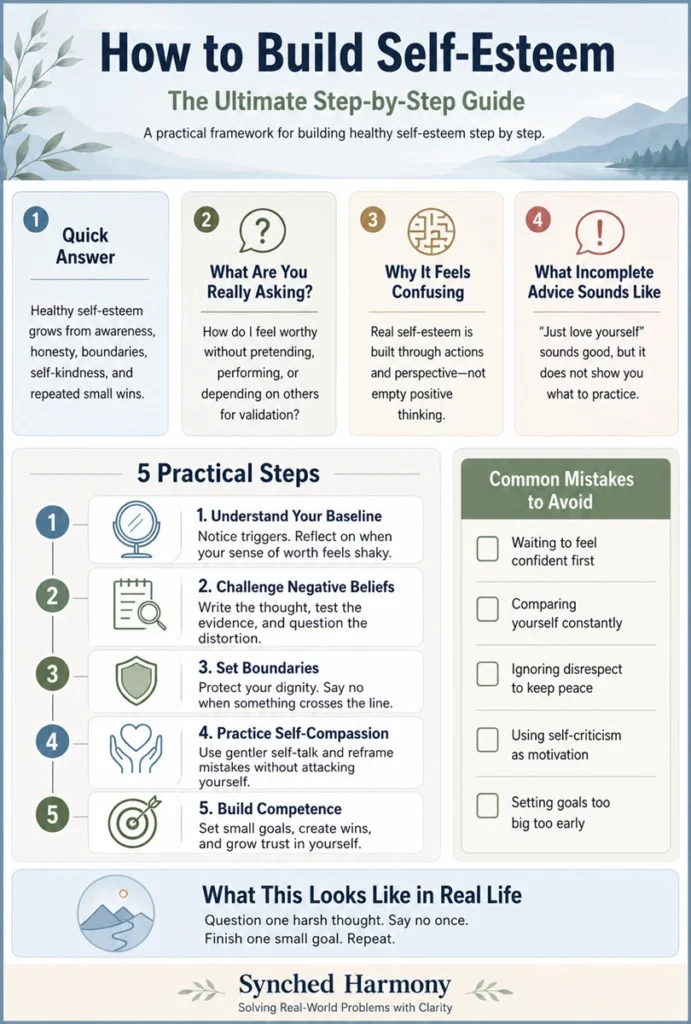
Quick Answer: What Really Builds Self-Esteem?
Internal link: For a related Synched Harmony guide, see Self Control Is Strength.
Self-esteem grows when you consistently align your internal narrative, values, and actions with genuine self-respect and kindness, independent of external validation. This requires manageable, daily habits that challenge negative beliefs and honor your dignity.
Here is a practical 5-step framework you can start applying immediately:
- Understand your self-esteem baseline and triggers
- Identify and challenge negative self-beliefs with real evidence
- Set and maintain boundaries that protect your mental dignity
- Practice self-compassion in realistic, non-defensive ways
- Build competence and recognize small wins in meaningful areas
In this guide, I’ll unpack each step with clear examples, common mistakes to avoid, and realistic considerations for edge cases.
What Are You Really Asking When You Want to Build Self-Esteem?
When people ask “How do I build self-esteem?”, they often seek relief from an internal cycle of harsh self-criticism, feelings of not measuring up, or being dependent on others’ approval to feel worthy. They’re asking: “How can I have peace with myself?”
In practice, low self-esteem commonly looks like:
- Constant self-doubt and negative internal dialogue
- Avoidance of new or challenging situations through fear of failure
- Difficulty saying no and excessive people-pleasing
- Heightened sensitivity to criticism or rejection
Recognizing that self-esteem is about sustained mental peace and genuine self-regard—not momentary confidence or bravado—is crucial for meaningful progress. This importance of mental well-being is echoed by the World Health Organization, which highlights a stable sense of self-worth as vital to psychological resilience and health WHO Mental Well-being.
Why Building Self-Esteem Feels Confusing in Real Life
You might have heard advice like “just think positive”, “fake it till you make it”, or “love yourself unconditionally.” Often, this advice doesn’t acknowledge the complex emotional roots of low self-esteem or the difficult social environments many face.
What I have noticed is that such generic advice often misses self-compassion:
- The emotional wounds or experiences that have shaped your sense of unworthiness
- How ongoing relationships and environments either support or hinder your growth
- The distinction between genuine self-esteem and external confidence or arrogance
This confusion can lead to frustration and feelings that change is impossible.
Why Common Advice Alone Is Incomplete
- Positive affirmations alone often feel hollow. Without addressing the underlying beliefs, repeating affirmations may temporarily distract but not heal.
- Telling yourself “don’t care what others think” dismisses genuine social needs and conditioning. Changing this takes time and context-aware effort.
- The ideal of “unconditional self-love” is admirable but can seem abstract and unattainable without concrete practices.
Most advice fails to provide clear, practical tools and realistic expectations for rebuilding self-esteem from the inside out.
A Practical 5-Step Framework to Build Healthy Self-Esteem
This framework synthesizes psychological insights and self-confidence tips, including Dr. Kristin Neff’s evidence-based research on self-compassion, which underlines its role in reducing self-criticism and supporting resilience (Neff, APA), practical observations, and everyday realities.

Step 1: Understand Your Self-Esteem Baseline and Triggers
Spend time reflecting on where your feelings of unworthiness began and identifying contexts that trigger self-doubt.
Example: Noticing your self-esteem drops around certain people or situations highlights relational wounds needing attention.
Step 2: Identify Negative Self-Beliefs and Gather Evidence
Write down the harsh thoughts you regularly tell yourself. For each, list factual evidence that supports and contradicts them.
Example: If you think “I’m not good enough,” recall moments when you succeeded or received genuine appreciation.
This practice challenges distorted thinking and gently reshapes your internal narrative.
Step 3: Set and Maintain Boundaries as an Act of Self-Respect
Define what behaviors from others you find unacceptable and practice communicating your limits clearly.
Important: Boundaries protect your dignity and mental peace—they are not selfish acts.
Example: Saying no to requests that drain your energy or disengaging from toxic conversations.
This aligns with NHS guidance that emphasizes boundaries as essential for mental well-being and confidence building NHS Building Self-Confidence.
Step 4: Practice Self-Compassion Over Harsh Self-Judgment
When you catch yourself in harsh self-talk, pause and reframe your thoughts as if speaking kindly to a close friend.
What I Learned:
[Insert personal observation here about how adopting self-compassion changed your self-esteem journey.]
Dr. Kristin Neff’s research suggests self-compassion enhances emotional resilience, reducing the harmful impact of self-criticism and promoting lasting self-esteem growth.APA on Self-Compassion
Step 5: Build Competence and Celebrate Small Wins
Choose skills or areas important to you. Set achievable goals, track progress, and acknowledge efforts regardless of the magnitude.
Example: Starting a small social interaction goal if social anxiety hinders confidence.
Recognizing progress builds belief in your abilities and reinforces a positive self-image.
9 Lessons from Personal Experience after Building Self-Esteem
- Not everyone deserves your company, respect, and time.
- Valuing yourself does not require anyone else’s approval.
- No matter how high you rise in life, your feet should always remain firmly on the ground.
- Sometimes, you need to give bullies a strong and firm response.
- The simplest way to build self-esteem is to face your challenges instead of running away from them.
- You begin to realize your internal value when you accept harsh realities and honestly assess yourself.
- Building self-esteem does not require putting others down or exaggerating your own worth.
- Self-esteem does not mean arrogance; it means making changes where growth is needed.
Realistic Examples and Edge Cases
- Long-term trauma or abuse survivors: Professional mental health support is often foundational before self-esteem work can begin effectively. The CDC notes professional intervention can be critical when low self-esteem is linked with mental health disorders CDC Program Evaluation.
- Unsupportive or toxic environments: Seek communities that respect your values or surround yourself with supportive individuals to counterbalance negative influences.
- Impostor syndrome: Remember, competence is often a spectrum; gradual improvement and acceptance of imperfection combat feelings of fraudulence.
Common Mistakes to Avoid
- Expecting immediate or overnight transformation
- Relying solely on positive thinking without resolving deeper beliefs
- Constantly comparing yourself to others, which undermines your intrinsic worth
- Neglecting boundaries due to guilt or fear of conflict
- Confusing self-esteem with perfectionism or arrogance
When to Seek Professional Help
If low self-esteem coincides with severe distress, depression, anxiety, or difficulty functioning, consulting a mental health professional is an important step. Building self-esteem is meaningful but can be challenging without support, especially in complex cases. This advice aligns with public health recommendations emphasizing appropriate professional care to complement personal strategies WHO Mental Health.
Frequently Asked Questions
What are the 5 C’s of self-esteem?
The 5 C’s are Control, Confidence, Contribution, Challenge, and Connection—key components underpinning healthy self-esteem and improve self-worth.
What practical steps can build self-confidence?
Focus on skill improvement, supportive social connections, manageable exposure to challenges, and positive, realistic self-talk.
How do I distinguish between self-esteem and ego?
Self-esteem is a stable, internal sense of worth; the ego often involves defensive pride or identity reliant on external validation.
Does self-esteem fluctuate daily?
Yes, self-esteem naturally varies with experiences, but a healthy baseline helps keep these changes manageable.
How long does building self-esteem take?
It varies widely; some notice changes within weeks, but meaningful, sustained growth generally requires months of consistent effort to increase self-esteem.
Source note: For broader context, review Effective project planning and evaluation in biomedical research.
Sources and References
- Effective project planning and evaluation in biomedical research – Go, very slowly, through the steps described in the Step-by-step guide. You may use the same example as for the Gantt chart.
- A field guide to qualitative research for new vaccine … – It guides the reader through a simple and step-wise process, building the skills needed to design and conduct qualitative formative research with key target …
- Implementation Research Toolkit – TDR – This Toolkit was developed by the Special Programme for Research and Training in Tropical. Diseases (TDR) to strengthen implementation research (IR) capacities …
- The overwhelming case for ending stigma and … – According to the Lancet Commission, the best way to reduce stigma is through social contact – prejudice-reducing interactions between people …
- A Guide to Creating Causal Loop Diagrams Participant … – When you name your variable, be sure to be as explicit as possible, and define all of your variables to make sure that there is a common understanding.
- HIV Triangulation Resource Guide – Triangulation should be considered as a viable option when a rigorous, specifically designed research study is not available, when such a study is not feasible, …
- Workbook 1 · Planning Evaluations – This workbook (Workbook 1) describes step-by-step methods for planning evaluations. These steps span from deciding who will be involved in the evaluation, …
- Framework for Operations and Implementation Research in … – Section B is the OR process flowchart and offers a step-by-step 16-item checklist of major activities required in the planning, implementation, and follow-up…
- Effective project planning and evaluation in biomedical research – It is designed to guide the participants through each step of the project planning and evaluation process. It gives step-by-step practical support during the …
- A guide to implementation research in the prevention … – IRIS – In this guide, implementation research is defined as “the scientific study of the processes used to implement policies and interventions and the contextual.
- Framework for Program Evaluation in Public Health – CDC developed the framework for program evaluation to ensure that, amidst the complex transition in public health, we will remain accountable and committed.
- Conducting a Field Investigation | Field Epi Manual – This chapter describes the step-by-step process required in performing an epidemiologic field investigation. The 10 steps covered here build on …

Hello, I’m Shubhankar — the voice behind Synched Harmony.
I created this space with one simple vision: to help people solve real problems with practical solutions and clarity. I’m someone who believes most confusion in life doesn’t come from lack of intelligence, but from lack of clear thinking and perspective. Through my writing, I try to break down everyday struggles into a simple, usable understanding. I write from my own reflections, observations, and real-life experiences—not theoretical advice. I’m not here to give perfect answers, but to offer clearer perspectives that actually make sense in real-life situations. Because I believe life becomes easier when we stop overcomplicating things and start understanding them better.